Contractor Abandoned the Job? Here's the 7-Step System (Not a Lawyer)
We didn't read the contract. We had no journal, no dated notes, no timestamped photos — and we thought that meant it was too late. It wasn't, and it isn't for you. Here is the escalation ladder, in order, with what each rung actually requires.
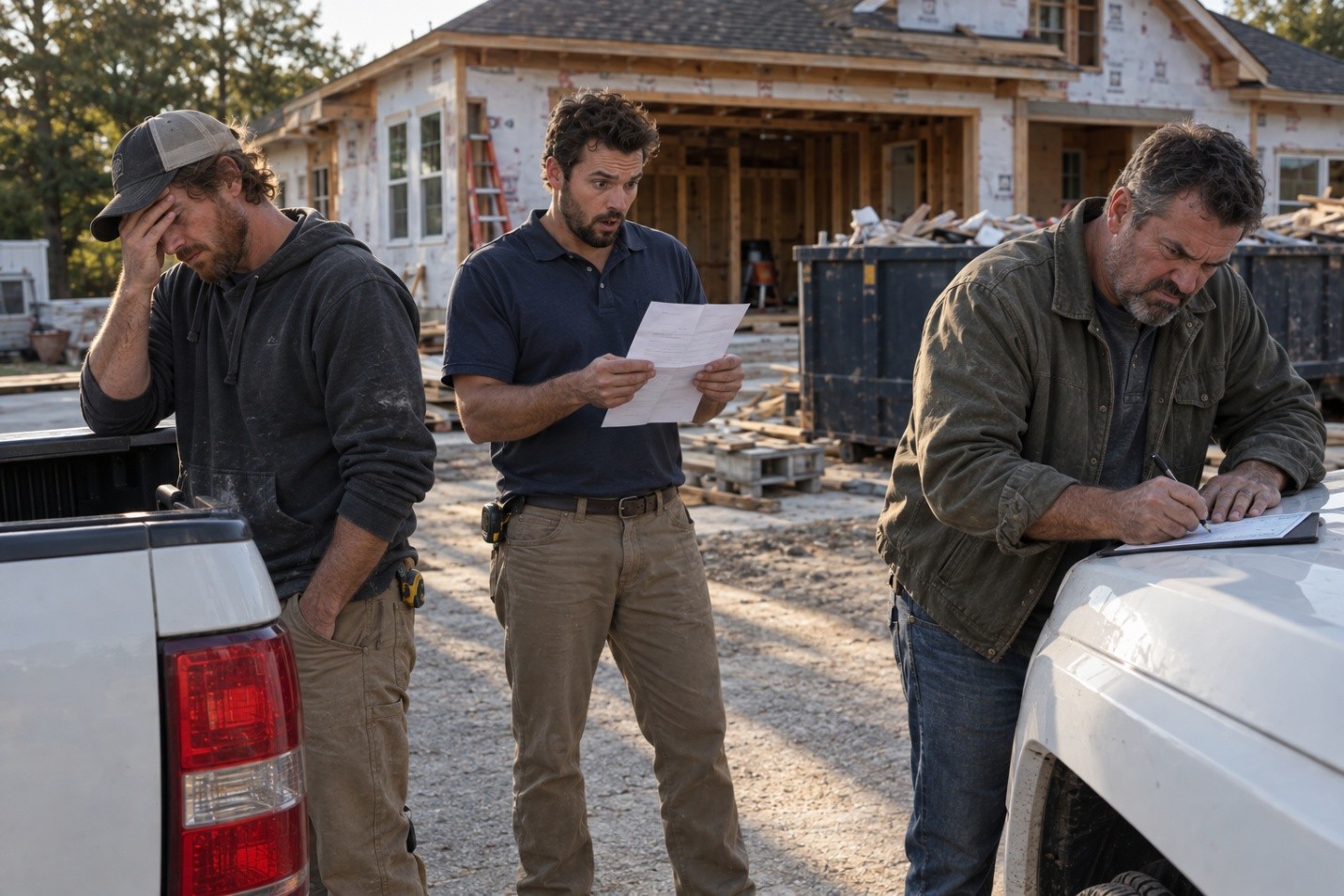
We didn't read the contract.
Not "skimmed it too fast." We signed it, filed it in a drawer, and didn't look at it again until things had already gone sideways. When we finally pulled it back out — mid-crisis, looking for anything that might help — we found out the entire contract wasn't about the work at all. It was liability protection. For him. If someone got hurt on our own site, that clause protected our contractor. Not us.
- We had no journal.
- No running spreadsheet.
- No documentation of any kind.
- No dated notes.
- No timestamped photos.
- Nothing beyond a folder of texts we'd never organized and mostly hadn't even kept.
By the time the wallboard dust had settled, we felt defeated in a very specific way. Not just angry at what had happened — certain there was nothing left to do about it.
There's no way I can prove any of this now. That was the thought. No paper trail, no proof, just our word against his.
None of that means it's too late for you.
Here's what I know now that I didn't know then: we had options. We just didn't know they existed, and we definitely didn't know what order to use them in. That's the gap this post closes — the research that eventually became this book (and its companion, Recourse Roadmap, coming this week) is the reason I can write this at all. And this works whether you're a US homeowner or a Canadian one — every step below covers both sides of the border, which is more than you'll get from whichever law firm's blog is also open in one of your other tabs right now.
What's inside:
- What You Actually Need
- The 7-Step Ladder
- Rungs 1–3: Conversation, Payment, the Letter
- Rungs 4–7: Licensing, Mediation, Legal Help, Small Claims
- Quick Reference
- FAQ
What You Actually Need — Before You Need It
Here's something you'll find very useful: every rung on this ladder has a price of admission. A specific thing you need before it actually works for you. Most homeowners find out what they were missing only after they need it. We did. Here's the list, top to bottom — starting with what the hardest rung requires, ending at the one that's free.
| To use... | You need... |
|---|---|
| Small claims court | A real, signed contract and dated, contemporaneous documentation — notes, emails, photos, invoices. A judge reads paper. Not memory. |
| A legal consultation worth paying for | The same file — your contract, plus a documented trail of everything you tried before you walked in the door. |
| Mediation | A contract, a documented record, and a contractor willing to sit down in the first place. A mediation where one side brings paperwork and the other brings recollection isn't really a negotiation. |
| A licensing board complaint | Proof the contractor is actually licensed, plus specific, dated facts about what went wrong. |
| A demand letter that actually lands | The specific contract clause it's citing, plus a documented account of what happened and when. Without that, it reads like a threat. With it, it reads like a case. |
| Withholding payment — and having it hold up | A written, milestone-based contract. Without one, "no work, no pay" isn't leverage. It's just an argument. |
| The direct conversation — the free rung | At minimum, having actually read your own contract. |
We had none of these. Not the paperwork for court. Not even the free one — we hadn't read our own contract closely enough to know what it actually protected (and, it turns out, who).
If you haven't started keeping a record yet, that's worth doing today, not after the next problem shows up — I wrote a whole post on exactly how to build one, and it doesn't take more than a few minutes a day. This is the moment it's built for.
The 7-Step Ladder
Not every problem warrants a lawsuit. Use the lowest rung that actually works, and only climb higher once the rung below it has genuinely been exhausted.
- Direct conversation — with documentation in hand.
- Withhold payment for the phase that's actually in dispute.
- Formal written demand letter.
- Licensing board complaint.
- Mediation.
- Legal consultation.
- Small claims or civil action.
Most disputes resolve somewhere between rungs two and four. The homeowners who end up in a courtroom are usually the ones who never kept a journal, never sent a formal letter, and never called the licensing board. By the time it gets that far, most contractors have stopped worrying about the outcome.
Rungs 1–3: The Conversation, the Money, the Letter
The first three rungs don't need a lawyer. They need a document in one hand and a specific problem in the other.
Rung 1 — the conversation. Specificity is the whole game here. Not "the work isn't done." Try: "The contract specifies rough electrical complete by May 15th. Today is May 22nd." One of those is a complaint. The other is a fact your contractor can't argue with. (For the actual mechanics of having this exact conversation without it turning into a fight, I wrote a separate post on standing your ground — that's the deep version of rung one. This post is about the whole ladder.)
Rung 2 — withhold payment. "No work, no pay" isn't aggressive. It's the agreement — if your contract is milestone-based, the money is only supposed to move once the milestone is actually complete. One hard line worth knowing: once you've paid for materials, they're yours. A contractor can't pull paid-for materials — or paid-for, completed work — off your site, even if the relationship falls apart entirely.
Rung 3 — the formal demand letter. Most advice stops at "send a demand letter" and calls it a day. Here's what actually needs to be inside one:
- Names the specific problem.
- Cites the contract clause that governs it.
- States exactly what you're requesting.
- Gives a deadline for a response or a fix.
Send it by email and certified mail. The combination is hard to ignore and even harder to deny later. (This is exactly what the Contractor Dispute Letter in the Template Toolbox is built to generate — modular by dispute type, with a built-in way to attach your prior communication log so the letter isn't starting from nothing.)
Rungs 4–7: Licensing, Mediation, Legal Help, and Small Claims
The last four rungs exist for when direct pressure hasn't worked. Each one is a bigger lever — not a bigger fight.
Rung 4 — licensing board complaint. In many states, a licensed contractor is backed by real money set aside for exactly this kind of situation — either a surety bond they're required to carry, or a state-run recovery fund built from every licensed contractor's fees, that you can file a claim against directly. Florida's fund runs up to $100,000. California skips the fund and requires a $25,000 bond instead. It's not a rumor — it's real, dedicated money sitting there with your name potentially on it.
The catch: most of it was built for someone buying a brand-new house, not a homeowner hiring someone to renovate an existing one. Ontario's Tarion fund and Quebec's RBQ plan both explicitly exclude renovation work — and it's a safe bet several US states do too. Before you count on this as a lever, check two things: does your state or province actually have one, and does it cover remodel/repair work specifically, not just new construction.
Rung 5 — mediation. Most disputes that end up in front of a judge were never really cases that needed one. They were communication failures where neither side backed down first. Mediation is faster, cheaper, and confidential compared to court, and it settles more often than you'd think.
Rung 6 — legal consultation. Notice where this sits. Not first — sixth. Every law firm's website you've read today (including whichever one brought you here) puts this step at the top. It doesn't belong there. Most construction attorneys offer a free or low-cost initial consultation, and it's genuinely useful even if you never retain them — but it's a scoping conversation, not your opening move.
Rung 7 — small claims or civil action. The last rung, and the one where documentation matters most. Limits vary more than you'd expect: in the US, they run from $2,500 in Kentucky to $25,000 in Tennessee. In Canada, from $5,000 in PEI to $50,000 in Ontario. (The Small Claims Court Prep Guide in the Toolbox breaks this down for all 51 US jurisdictions and all 13 Canadian provinces and territories, if you get this far.)
Quick Reference
- The ladder: conversation → withhold payment → demand letter → licensing complaint → mediation → legal consult → small claims
- Before any of it: a real contract, a real record
- Rule of thumb: use the lowest rung that works — most disputes resolve between rungs two and four
- The line that matters most: if it wasn't written down, it didn't happen
FAQ
When is a contractor considered to have abandoned a job?
There's no single universal trigger — check your own contract's termination clause first. Common ones: work stopped for a set number of days, missed milestones with no written revised schedule, or a lapse in required insurance.
Can I withhold payment if my contractor hasn't finished the work?
Yes — for the specific phase that's incomplete or defective. When payment is tied to milestones, this isn't a breach on your part. It's the agreement working the way it's supposed to.
Do I need a lawyer to file a licensing board complaint?
No. Most boards have an online complaint form you can fill out yourself. A lawyer becomes useful later in the sequence, not at this step.
What's the real difference between mediation and small claims court?
Mediation is a facilitated conversation aimed at agreement — faster, cheaper, confidential. Small claims puts a judge or magistrate in charge of deciding for you. It's the last rung for a reason.
Do small claims limits really differ that much between the US and Canada?
Yes. US limits range from $2,500 to $25,000 depending on the state. Canadian limits range from $5,000 to $50,000 depending on the province.
Before You Need This Again
The Contractor Dispute Letter and the Small Claims Court Prep Guide (available FREE for a limited time) exist for exactly rungs three and seven of this ladder — built so you're not staring at a blank page at the exact moment you're least equipped to write one.
And if your situation is bigger than a contractor — a bad landlord, a bad vendor, any contract gone wrong — Recourse Roadmap is coming this week, built for that wider version of the same problem.
I learned the hard way. You don't have to.

Blog by Clinton Treece, author of “The 16 Things I Wish I'd Known Before I Hired A Contractor”.