Go straight to the 16 things!

The homeowner's field guide

How to Hire a Contractor:16 Things I Wish I'd Known First

Hey, I'm Clinton Treece, software architect and engineer. My father built 17 custom homes. I've been around carpentry and construction all my life -- and I massively fumbled my retirement renovation project to the tune of $260,000.

I'm not a contractor, an attorney, or a licensing expert. I'm the homeowner who documented what went wrong and wrote the system I didn't have.

If you're asking yourself, “I have no idea what questions I should even be asking”... “16 Things” is written for you.

I've placed below, FREE TO READ, All 16 lessons I learned so you're less likely to watch a project drain your bank account, retirement, or self-respect.

Clinton and Tabitha Treece smiling close together outdoors in front of green trees
Clinton and Tabitha TreeceWe made it through, a little wiser and a lot stronger.

Our contractor's exact words:
“You're out of money. We're all done.” -- I didn't know, but I had to move my family in anyway.

On August 1, 2024, I moved my family of five into a house that wasn't finished.

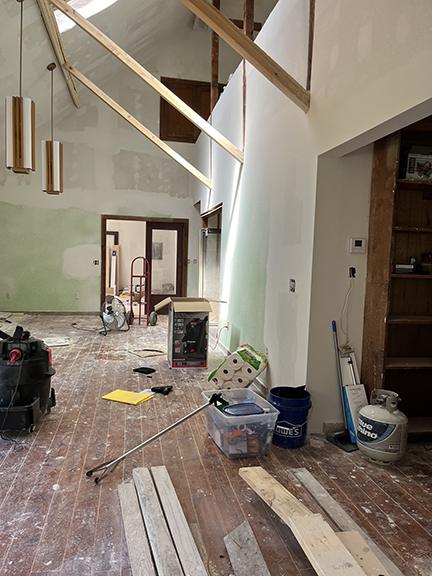
Half the lights worked. The light switches were wired wrong: the living room switch turned on the kitchen lights. The bathroom was plumbed but had no sewer exhaust. The bedroom smelled like sewer gas. The floors were covered in drywall mud.

The contractor who managed it and did the majority of framing had taken my money, weekly, as I needed to keep things moving, until there was no money left and fourteen promised items were still unfinished.

He said it after I'd written the final checks. I had paid everyone in full before the work was done. $2,000 to the plumber. $6,000 to the electrician. $7,000 to the drywaller. $12,000 in final contractor fees.

I wasn't a reckless person.

I wasn't an uninformed one. I had done what felt like the right things. I hired someone my realtor recommended. I paid as work progressed. I held emergency meetings when things stalled. I personally sourced replacement subcontractors when his fell through.

And I still ended up in a house I couldn't finish and couldn't refinance, because the contractors had already been paid in full.

When I went back to my banker and explained that the plumbing and electrical still weren't complete but that the contractors had assured me they'd come back to finish, he stopped me with one question.

Banker: “That last payment, was it 'paid in full'?”

Me: “Yes.”

Banker: “Good luck getting them back out here.”

He wasn't being unkind. He was telling me the truth I had not been equipped to see before I needed to see it. I hadn't lost my leverage at the end. I had given it away, one weekly check at a time, without understanding what I was handing over.

It was then that the absolute reality of the situation hit me.

I got two more loans to finish the property, mostly for materials, as I had to complete it myself (with a lot of help from friends). It almost killed me with the stress, heat, ladder climbing, frustration, and waking up at 3:30 am every morning, panicking about how this was all going to get done by the deadline.

In the middle of this mess, while still working a full-time job, on a coffee break, I got the idea: “Damn. If I wrote down everything that I learned, it would sure be helpful to the next person behind me. And it's not even that complicated.”

So I wrote 16 things that I would do differently. Now, here we are.

I am not a contractor attorney. I am not a licensing expert or a construction consultant. What I am is a homeowner who documented everything that went wrong, researched every better path I could have taken, and built a system out of that, so that the next person standing where I stood has something I didn't.

Clinton Treece
Author, 16 Things I Wish I'd Known BEFORE I Hired A Contractor

I realized I should write a book, and save everyone else the trouble.

I spent the next year and a half researching and pulling together information and best practices for 16 things that I know I'd do differently the next renovation.

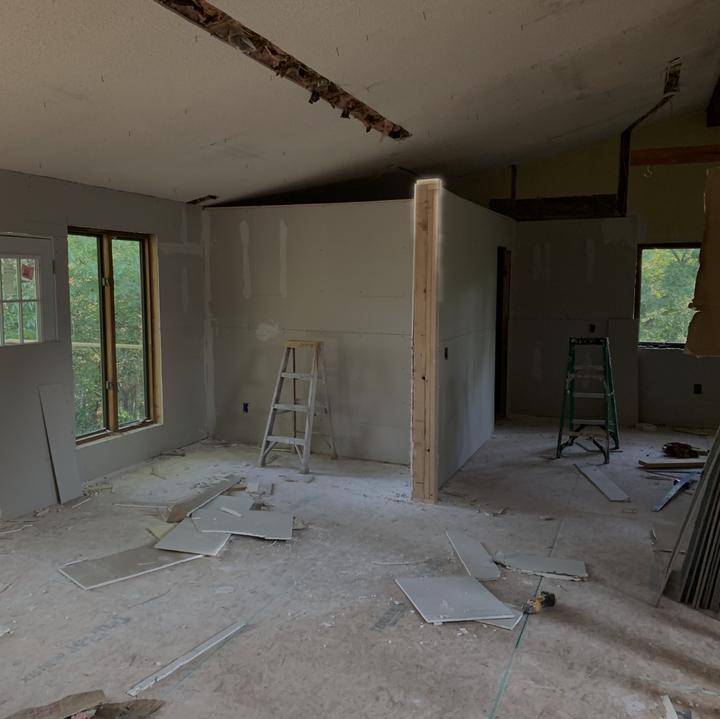
A half-finished room with drywall on the walls, an open ceiling, two ladders and debris on the subfloor, photographed July 10, 2024
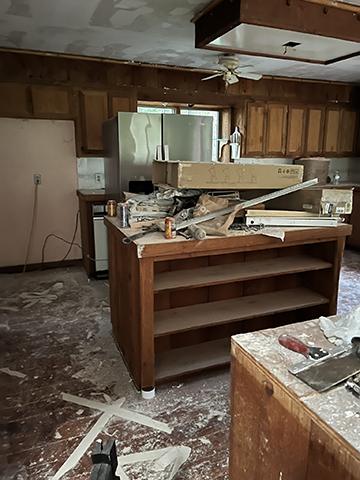
Kitchen during demolition
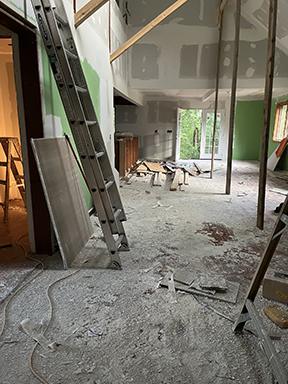
Living and dining area during rough construction
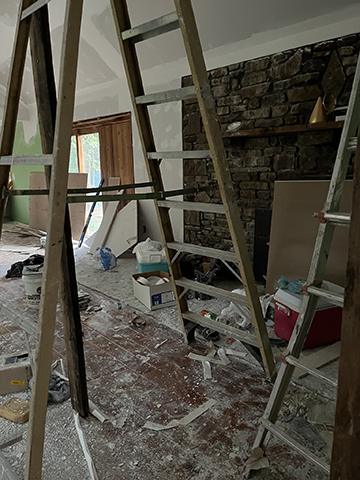
Ladders and building materials around an unfinished fireplace
Living room during drywall installation
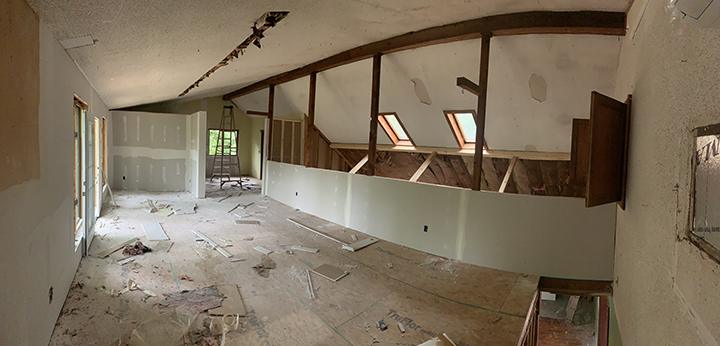
Upstairs room during drywall work
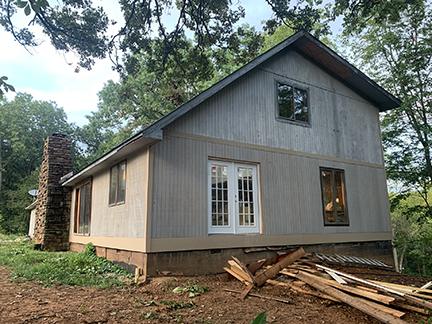
Finished exterior addition
1 / 7

Real photo, July 10, 2024: our contractor left this job half-finished.

So Here they are: The 16 things that I've learned

The illustrations on these cards are AI-generated. The renovation photos above are real. Numbers tagged rule of thumb are common guidelines, not legal limits. Rules differ by state and province.

The 16 things fall into three groups, in the order a renovation unfolds. Select a group to jump straight to it.

Before anyone shows up (Things 1 to 10)

AI-generated illustration: Understand your power sits in three things

Thing 01

Understand your power sits in three things

What's happening

I walked into my own renovation trusting goodwill instead of a system. Goodwill has an expiration date: it ends the moment the job begins.

You have more leverage than you think, and it comes from exactly three places. Lose track of any one of them and the other leverage points weaken.

  • The Bid. Not an estimate. Line-item, written, from at least three contractors.
  • The Contract. Negotiated, never signed as-is. Attorney review above $60–70K.rule of thumb
  • The Money. 10–15% deposit, milestone payments, you write every check.rule of thumb
What to avoid
  • Don't proceed on a verbal number.
  • Don't sign the contractor's draft as-is.
  • Don't pay against elapsed time or crew presence. Pay against completed, verified milestones only.
From The Manual, Chapter 1 and Entries 1.1 to 1.3
AI-generated illustration: Ask for a bid, not an estimate

Thing 02

Ask for a bid, not an estimate

What's happening

An estimate is a direction, not a commitment: it has no floor (or ceiling), and every surprise becomes a reason to charge more. A bid is a contractor committing to a fixed number you can hold them to.

What to avoid
  • Don't accept “estimate” language as interchangeable with “bid.”
  • Don't proceed on a verbal number.
  • A flat refusal to commit to any fixed scope or number is a red flag. Note it, don't ignore it.
From The Manual, Entry 1.1
AI-generated illustration: Build informed criteria for choosing a contractor

Thing 03

Build informed criteria for choosing a contractor

What's happening

A license means the state or province has a minimum floor of competence and a complaint/discipline mechanism. It is earned and renewed, typically every two years.rule of thumb

What to avoid

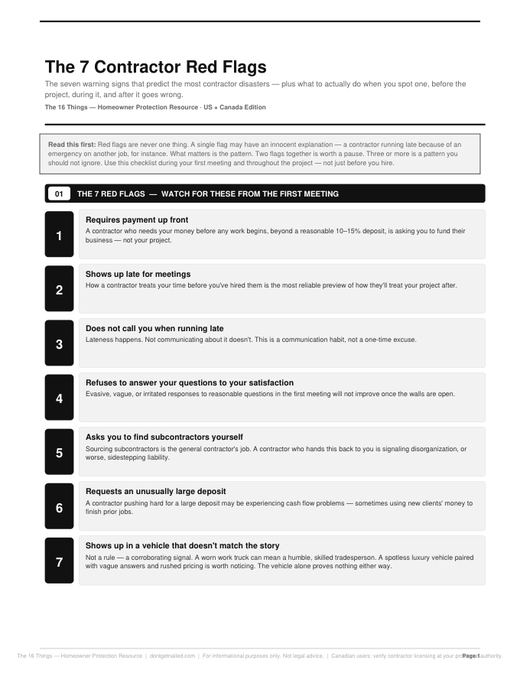
Seven red flags (none disqualifying alone; watch for clusters):

  • Requires payment beyond a reasonable deposit up front
  • Shows up late without notice
  • Doesn't call to say they're running late
  • Vague or irritated answers to questions
  • Asks you to source your own subcontractors
  • Pushes hard for a large deposit
  • Vehicle/appearance doesn't match the story told (corroborating detail only, never standalone)
From The Manual, Entries 2.2 and 2.5
AI-generated illustration: Don't accept the first contract. Negotiate it.

Thing 04

Don't accept the first contract. Negotiate it.

What's happening

The contract they wrote protects them, not you. Vague scope, contractor-favorable change-order language, and front-loaded payment terms sit in plain view in the document you're about to sign.

What to avoid
  • Don't sign the contractor's draft as-is.
  • Don't treat a contractor's defensiveness about revisions as a hiccup. It's information.
From The Manual, Entry 1.2
AI-generated illustration: Require a 10% overage fund in your budget

Thing 05

Require a 10% overage fund in your budget

What's happening

This is a private buffer against genuine surprises (rotted subfloor, undisclosed load-bearing wall, non-code wiring), and against the pressure to rush-approve change orders because the crew is standing idle.

What to avoid
  • Do not tell the contractor it exists.
  • Do not fold it into the visible project budget.
From The Manual, Entry 3.1
AI-generated illustration: Define clearly what “done” looks like

Thing 06

Define clearly what “done” looks like

What's happening

Define what “done” looks like in one written sentence before pricing is discussed. That sentence becomes the contract.

What to avoid
  • Don't accept a single completion date as a substitute for a phased schedule.
  • Don't leave “abandonment” or “communication failure” undefined. Vague language here means no enforceable exit.
From The Manual, Entries 3.2, 3.6 and 7.1
AI-generated illustration: Negotiate a milestone-based payment schedule

Thing 07

Negotiate a milestone-based payment schedule

What's happening

Once a contractor has your money, the incentive to prioritize your job drops. Control of the payment schedule is what keeps the relationship honest for the length of the project, not just at the bid stage.

What to avoid
  • A deposit request of 30% or more is a threshold that should give you pause. It may simply mean the payment conversation hasn't happened yet.rule of thumb
  • Don't pay against elapsed time or crew presence. Pay against completed, verified milestones only.
From The Manual, Entry 1.3
AI-generated illustration: Negotiate a cleanup schedule and responsibilities

Thing 08

Negotiate a cleanup schedule and responsibilities

What to avoid
  • Don't assume cleanup is included by default. Unless it's written in, you have no standing to require it, and could end up with a real mess on your hands.
From The Manual, Entry 3.5
AI-generated illustration: Require more detail in invoices

Thing 09

Require more detail in invoices

What's happening

Put the invoice standard in the contract itself. A verbal agreement about billing is not an agreement.

From The Manual, Entry 3.4
AI-generated illustration: Never agree to a permit-less process

Thing 10

Never agree to a permit-less process

What's happening

A permit is what makes an independent inspector, someone with no financial stake in your project, check the work before it's sealed behind drywall.

What to avoid
  • “It'll take too long” or “you don't really need one for a job this size” is a red flag. Permit avoidance on structural/mechanical work tracks with avoidance of scrutiny generally.
From The Manual, Entry 4.1

While the work is happening (Things 11 to 15)

AI-generated illustration: Keep a written and photo journal

Thing 11

Keep a written and photo journal

What's happening

If it wasn't written down, it didn't happen. That's how disputes are decided.

What to avoid
  • Don't rely on memory for anything. Write same-day entries.
  • An unsigned change request is a conversation, not a change order. Don't treat it as authorization.
From The Manual, Chapter 5 and Entry 5.1Back to beginning
AI-generated illustration: Monitor your budget closely

Thing 12

Monitor your budget closely

What's happening

If you've paid 80% of the contract but the project is only 60% complete, that gap is a leverage problem: your remaining payment (your primary protection) is shrinking faster than the work. This gap has a name: Leverage Ratio = % of Contract Paid ÷ % of Project Complete. A ratio of 1.0 means payment and progress are matched.

What to avoid
  • Don't read the ratio literally right after the deposit. A 10–15% deposit paid before any work starts (Entry 1.3) makes the ratio artificially high or undefined: 15% paid ÷ 0% complete tells you nothing yet.
From The Manual, Entry 6.2Back to beginning
AI-generated illustration: Take change orders and extra asks seriously

Thing 13

Take change orders and extra asks seriously

What's happening

Individually small approvals compound. By the third or fourth change order, your mental model of the budget is often wrong by 20%+ if you're not tracking cumulatively.rule of thumb

What to avoid
  • Never authorize a change verbally.
  • Never accept a price described as “roughly” or “around.”
  • Don't treat change orders as isolated events. Track the cumulative total, not just each new number.
From The Manual, Entries 7.1 and 7.2Back to beginning
AI-generated illustration: Visit the site regularly

Thing 14

Visit the site regularly

What's happening

The permit inspector wants one thing: code compliance. That's your interest too.

What to avoid
  • Don't let an unclear answer sit unresolved. Thirty seconds of follow-up now is cheaper than the same question after drywall goes up.
From The Manual, Chapter 8 and Entry 8.3Back to beginning
AI-generated illustration: Demand anything broken be fixed immediately

Thing 15

Demand anything broken be fixed immediately

What's happening

Damage deferred is damage absorbed. The moment something breaks is the only moment you have real leverage to make it right.

What to avoid
  • Don't accept “we'll take care of that at the end.” End-of-project is the point of minimum leverage for you, not a neutral deferral.
  • Don't rely on a verbal agreement. Follow up any verbal repair commitment with a same-day written confirmation.
From The Manual, Chapter 9 and Entry 9.1Back to beginning

When things go sideways (Thing 16)

AI-generated illustration: Know your options of recourse and who to call

Thing 16

Know your options of recourse and who to call

What's happening
  1. Direct conversation, documented
  2. Withhold payment for the disputed phase
  3. Formal written demand letter
  4. Licensing board complaint (parallel-eligible)
  5. Mediation
  6. Legal consultation
  7. Small claims or civil action
What to avoid
  • Don't skip steps. Most disputes resolve between steps 2 and 4. Homeowners who end up in court are usually the ones who never kept a journal or sent a formal letter.rule of thumb
From The Manual, Entry 11.9Back to beginning

Just for visiting...

Free, printable downloads

Yours to keep, print as many as you like, with no sign-up. Use them on your first call or meeting.

The first page of The 7 Contractor Red Flags

Red Flags

The 7 warning signs that predict the most contractor disasters, and what to do when you spot one: before the project, during it, and after it goes wrong.

Download the PDF, free
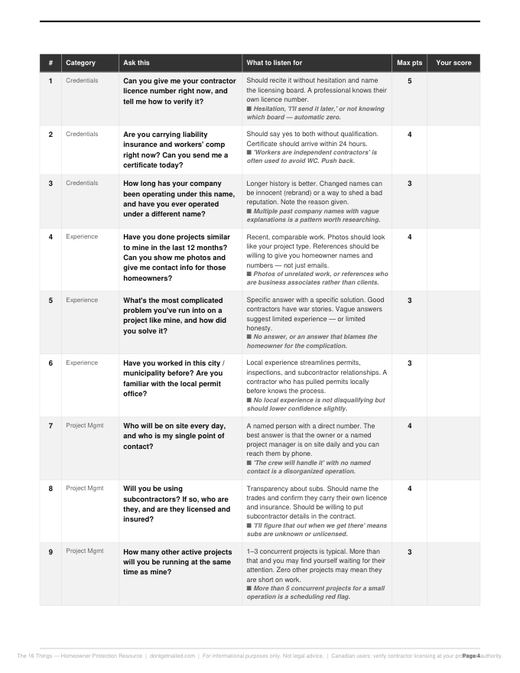
A page from the Contractor Interview Worksheets showing scored interview questions

Contractor Interview Worksheets

18 scored questions across 6 categories, with a scoring key and a side-by-side tracker so you can grade every contractor the same way.

Download the PDF, free

I learned all of this the hard way so you don't have to.

...However, the devil is in the details!

Cover of 16 Things I Wish I'd Known BEFORE I Hired A Contractor, The Manual

Comes with bonus Contractor Interview Toolkit

Take a look inside: all of Chapter 1, including its Quick Reference.

The Manual

16 Things I Wish I'd Known BEFORE I Hired A ContractorThe Manual

$1653 pages, PDF

This eBook is the anchor to the series.

An OVERVIEW of an entire project, all 16 things condensed. It's a reference you open mid-crisis. Every entry stands alone, and each one is built the same way: the situation that sends you there, what's happening, what to avoid, and what to do. If you only have thirty seconds, read the bolded lines.

Here are the chapters...

  • How To Use Your Leverage: The Bid, The Contract, Your Money
  • Three Tells Of A Good Contractor (And How To Spot Them)
  • Get These Six Terms In Writing Before You Sign
  • How To Make Permits Your Secret Weapon
  • This Easy Habit Will Save Your A$$: The Project Journal
  • Never Pay an Invoice You Haven't Checked
  • Keep "Extras" (Change Orders) From Eating Your Budget
  • What to Look for Every Time You Walk the Site
  • What To Do When Your Property Gets Damaged
  • What to Do When the Job Stalls: Your Four Levers
  • When Things Get Legal: How To Keep Your Dispute Out of the Courtroom
  • Quick-lookup resource index

Not satisfied? Email clinton@the16things.com within 30 days for a full refund.

Need a walk-through? Unique situation??

Book a personal call

$75for one hour

The books are written so you can do this on your own. But sometimes reading isn't the fastest way through. A call might be right for you if:

  • You don't have time to read. The project is coming, and you need the short version that fits your job, not all 16 things.
  • Your renovation has already started. You're past the bid and the contract, and you want to know what to watch, what to write down, and what to do before the next payment.
  • Things have gone sideways, and it's starting to feel legal. We'll sort out where you stand, what you have on paper, and which step on the ladder comes next. (I'm not an attorney, so if you need one, I'll help you get organized before you call one.)
  • The whole thing is just overwhelming. Too many decisions, too many directions, and no idea which one matters first.

Talking it through gets you there faster. You tell me where you are. I help you sort out what matters now, clear up the parts that don't make sense, and you leave the call with your next steps written down.

What the hour covers

  1. A quick Q&A so I understand your project and where it stands.
  2. A walk-through of your situation using The Manual.
  3. Answers to the process questions that are keeping you up at night.

Every call includes a free copy of The Manual.

Not satisfied? Email clinton@the16things.com within 30 days for a full refund.

I'm not a contractor, an attorney, or a licensing expert. Calls share what I learned as a homeowner and are not legal advice.

Pick a time